Friday, January 25, 2019

Monday, December 31, 2018
A Look Back at the 2018 CHPC Conference in South Africa
In this podcast, the Radio Free HPC team looks back at the highlights of the 2018 CHPC Conference in South Africa. With over 500 attendees, the event featured a set of keynotes on high performance computing as well as a Student Cluster Challenge and a Cyber Security Competition.
The comprehensive program included national and international contributions as well as contributions from cyberinfrastructure system partners: the South African National Research Network and the Data Intensive Research Initiative of South Africa. Captains of the HPC Industry across the globe provided key talks and workshops during the conference week and they included: Patricia Damkrogel, Vice President and General Manager of Intel, Thomas Sterling from Indiana University, USA; Michael Foley who has recently retired from the World Bank, Bhekisipho Twala from the University of South Africa, Khutso Ngoasheng from the South African Radio Astronomy Observatory, Elmarie Biermann from the Cyber Security Institute and many others.
Sign up for our insideHPC Newsletter
The comprehensive program included national and international contributions as well as contributions from cyberinfrastructure system partners: the South African National Research Network and the Data Intensive Research Initiative of South Africa. Captains of the HPC Industry across the globe provided key talks and workshops during the conference week and they included: Patricia Damkrogel, Vice President and General Manager of Intel, Thomas Sterling from Indiana University, USA; Michael Foley who has recently retired from the World Bank, Bhekisipho Twala from the University of South Africa, Khutso Ngoasheng from the South African Radio Astronomy Observatory, Elmarie Biermann from the Cyber Security Institute and many others.
This year, following the theme of the conference on how HPC Transforms for the Future, increasing the participation of women in HPC was prominent. This was supported by the introduction of a sponsorship for an outstanding female in the Student Cluster Challenge. The award in this newly introduced category, sponsored by Intel, was taken by Ms. Mapule Madzena, a student from the University of the Free State. She was hailed as the best female student and walked away with R64 500.Download the MP3 * Subscribe on iTunes * RSS Feed
Sign up for our insideHPC Newsletter
Friday, December 28, 2018
A Hard Look at Santa's Big Data Requirements
[caption id="attachment_67821" align="alignright" width="300"]
 From left, Henry Newman, Dan Olds, Shahin Khan, and Rich Brueckner are the Radio Free HPC team[/caption]
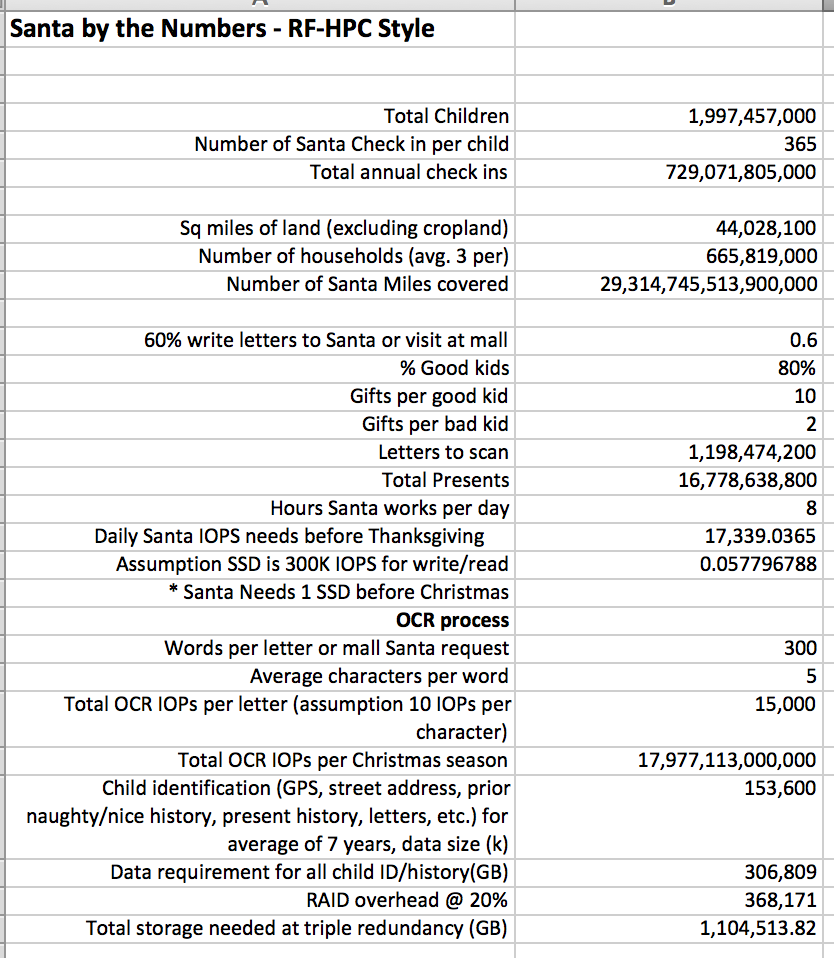
In this podcast video, the Radio Free HPC team looks at the monumental IT challenges that Santa faces each Holiday Season.
With nearly 2 billion children to serve, Santa’s operations are an IT challenge on the grandest scale. If the world’s population keeps growing by 83 million people per year, Santa may need to build a hybrid cloud just to keep up. With billions of simultaneous queries, the Big Data analytics required will certainly require an 8-socket numa machines with 4 terabytes of central memory.Sign up for our insideHPC Newsletter
Download the MP3 * Subscribe on iTunes * RSS Feed
Monday, November 26, 2018
Looking at TOP500 Trends for Exascale at SC18
In this podcast, the Radio Free HPC team looks at the semi-annual TOP500 BoF presentation by Jack Dongarra.
See our complete coverage of SC18
Sign up for our insideHPC Newsletter
Download the MP3 * Subscribe on iTunes * RSS Feed
The TOP500 list of supercomputers serves as a “Who’s Who” in the field of High Performance Computing (HPC). It started as a list of the most powerful supercomputers in the world and has evolved to a major source of information about trends in HPC. The 52nd TOP500 list will be published in November 2018 just in time for SC18. This BoF will present detailed analyses of the TOP500 and discuss the changes in the HPC marketplace during the past years. The BoF is meant as an open forum for discussion and feedback between the TOP500 authors and the user community.After that, we do our Catch of the Week.
See our complete coverage of SC18
Sign up for our insideHPC Newsletter
Download the MP3 * Subscribe on iTunes * RSS Feed
Saturday, November 17, 2018
Running Down the TOP500 at SC18
In this podcast, the Radio Free HPC team looks back on the highlights of SC18 and the newest TOP500 list of the world's fastest supercomputers.
[caption id="attachment_71623" align="alignright" width="300"] Buddy Bland shows off Summit, the world's fastest supercomputer at ORNL.[/caption]
The latest TOP500 list of the world's fastest supercomputers is out, a remarkable ranking that shows five Department of Energy supercomputers in the top 10, with the first two captured by Summit at Oak Ridge and Sierra at Livermore. With the number one and number two systems on the planet, the "Rebel Alliance" vendors of IBM, Mellanox, and NVIDIA stand far and tall above the others.
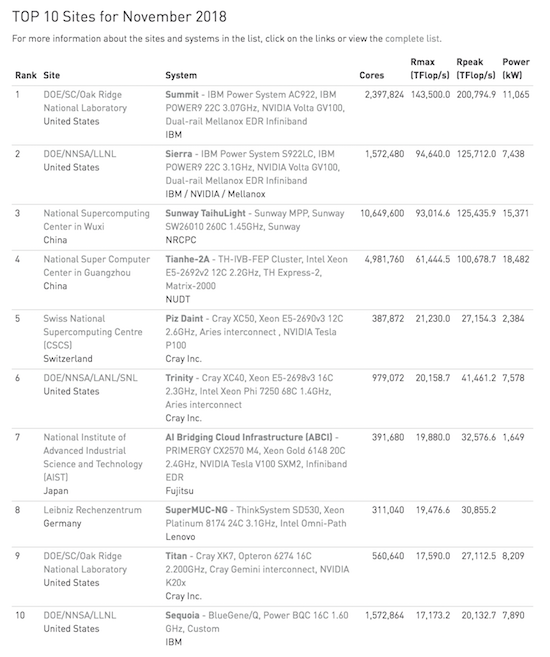
At number five is Piz Daint, a Cray XC50 system installed at the Swiss National Supercomputing Centre (CSCS) in Lugano, Switzerland. At 21.2 petaflops, it maintains its standing as the most powerful system in Europe. It is powered by a combinations of Intel Xeon processors and NVIDIA Tesla P100 GPUs
Sign up for our insideHPC Newsletter
Download the MP3 * Subscribe on iTunes * RSS Feed
[caption id="attachment_71623" align="alignright" width="300"] Buddy Bland shows off Summit, the world's fastest supercomputer at ORNL.[/caption]
The latest TOP500 list of the world's fastest supercomputers is out, a remarkable ranking that shows five Department of Energy supercomputers in the top 10, with the first two captured by Summit at Oak Ridge and Sierra at Livermore. With the number one and number two systems on the planet, the "Rebel Alliance" vendors of IBM, Mellanox, and NVIDIA stand far and tall above the others.
Summit widened its lead as the number one system, improving its High Performance Linpack (HPL) performance from 122.3 to 143.5 petaflops since its debut on the previous list in June 2018. Sierra also added to its HPL result from six months ago, going from 71.6 to 94.6 petaflops, enough to bump it from the number three position to number two. Both are IBM-built supercomputers, powered by Power9 CPUs and NVIDIA V100 GPUs.
At number five is Piz Daint, a Cray XC50 system installed at the Swiss National Supercomputing Centre (CSCS) in Lugano, Switzerland. At 21.2 petaflops, it maintains its standing as the most powerful system in Europe. It is powered by a combinations of Intel Xeon processors and NVIDIA Tesla P100 GPUs
Trinity, a Cray XC40 system operated by Los Alamos National Laboratory and Sandia National Laboratories improved its performance to 20.2 petaflops, enough to move it up one position to the number six spot. It uses Intel Xeon Phi processors, the only top ten system to do so.See our complete coverage of SC18
Sign up for our insideHPC Newsletter
Download the MP3 * Subscribe on iTunes * RSS Feed
Tuesday, November 6, 2018
A Look at the Spaceborne Supercomputer One Year Later
In this podcast, the Radio Free HPC team sits down with Mark Fernandez from HPE to discuss the Spaceborne Supercomputer that it currently orbiting the planet in the International Space Station.
Last week, HPE announced it is opening high-performance computing capabilities to astronauts on the International Space Station (ISS) as part of its continued experiments on the Spaceborne Computer project.
Spaceborne Computer is the first commercial off-the-shelf (COTS) supercomputer that HPE and NASA launched into space for a one-year experiment to test resiliency and performance, achieving one teraFLOP (a trillion floating point operations per second) and successfully operating on the International Space Station (ISS). After completing its one-year mission proving it can withstand harsh conditions of space – such as zero gravity, unscheduled power outages, and unpredictable levels of radiation – Spaceborne Computer will now, for the first time ever, open its supercomputing capabilities for use aboard the ISS. These “above-the-cloud” services will allow space explorers and experimenters to run analyses directly in space instead of transmitting data to and from Earth for insight.
After that, we do our Catch of the Week.
Download the MP3 * Subscribe on iTunes * RSS Feed
Sign up for our insideHPC Newsletter.
Last week, HPE announced it is opening high-performance computing capabilities to astronauts on the International Space Station (ISS) as part of its continued experiments on the Spaceborne Computer project.
Spaceborne Computer is the first commercial off-the-shelf (COTS) supercomputer that HPE and NASA launched into space for a one-year experiment to test resiliency and performance, achieving one teraFLOP (a trillion floating point operations per second) and successfully operating on the International Space Station (ISS). After completing its one-year mission proving it can withstand harsh conditions of space – such as zero gravity, unscheduled power outages, and unpredictable levels of radiation – Spaceborne Computer will now, for the first time ever, open its supercomputing capabilities for use aboard the ISS. These “above-the-cloud” services will allow space explorers and experimenters to run analyses directly in space instead of transmitting data to and from Earth for insight.
After that, we do our Catch of the Week.
Download the MP3 * Subscribe on iTunes * RSS Feed
Sign up for our insideHPC Newsletter.
Monday, October 29, 2018
A Preview of the SC18 Student Cluster Competition
In this podcast, Radio Free HPC Previews the SC18 Student Cluster Competition.
Sign up for our insideHPC Newsletter.
The Student Cluster Competition was developed in 2007 to provide an immersive high performance computing experience to undergraduate and high school students. With sponsorship from hardware and software vendor partners, student teams design and build small clusters, learn designated scientific applications, apply optimization techniques for their chosen architectures, and compete in a non-stop, 48-hour challenge at the SC conference to complete a real-world scientific workload, showing off their HPC knowledge for conference attendees and judges. Teams are composed of six students, at least one advisor, and vendor partners. The advisor provides guidance and recommendations, the vendor provides the resources (hardware and software) and the students provide the skill and enthusiasm. Students work with their advisors to craft a proposal that describes the team, the suggested hardware, and their approach to the competition. The SCC committee reviews each proposal and provides comments for all submissions received before the deadline."Download the MP3 * Subscribe on iTunes * RSS Feed
Sign up for our insideHPC Newsletter.
Subscribe to:
Posts (Atom)